|
|
Boy Scouts & Girl Scouts
The New England Outdoor Center is the leader in providing complete whitewater rafting and outdoor recreation for Boy and Girl Scout groups.
We enjoy working with young people and firmly believe in the value of challenging outdoor recreation. We also take our role in keeping your group busy, happy, challenged and enriched, in a drug and alcohol-free environment, as seriously as you do.
NEOC is proud to offer these scout whitewater rafting experiences in Maine at reduced prices, but don't expect reduced value. Our staff is committed to delivering the highest quality of Scout whitewater rafting, group accommodations, and overall resort experience that are guaranteed to exceed your expectation. This way your scout, the masters, and parents can rest assured that your programming dollar is well spent.
Looking for Merit Badges? New England Outdoor Center is the scout troup's one stop shop for both the Canoeing Merit Badge and the Whitewater Merit Badge.
Let us put our decades of experience to work for you!
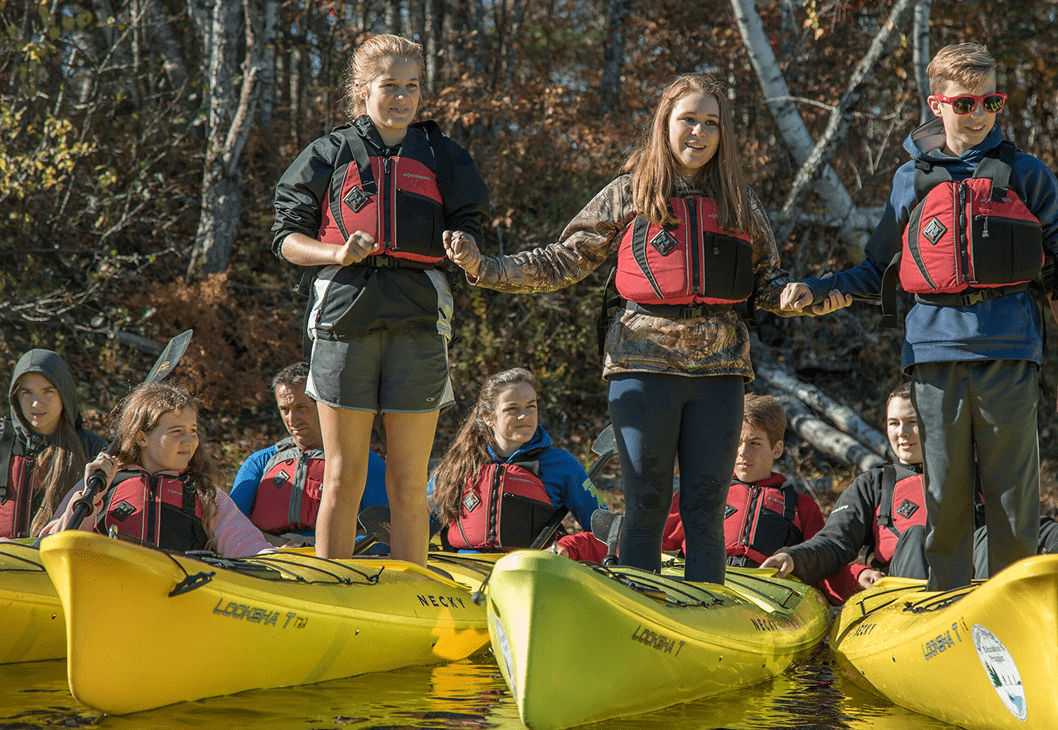
The New England Outdoor Center offers the perfect setting for the pursuit of both the Canoeing Merit Badge and the Whitewater Merit Badge. With all of the equipment on site, groups pursuing both the Canoeing Merit Badge and the Whitewater Merit Badge may first use center resources for a nominal charge to pursue with their own scoutmasters the Canoeing Merit Badge (we are also happy to package a full day of programming on the Canoeing Merit Badge with our registered guides and instructors) and then add a day of guided whitewater rafting with specific instruction and time to demonstrate proficiency in the Whitewater Merit Badge requirements. The day of whitewater rafting in Maine takes place on either Maine's Kennebec or Penobscot River.
Scouts should arrive at the Center with the first aid and CPR requirements already accomplished.
|
|
|
These documents are in PDF format. You will need the free Acrobat Reader to view them.
|

|
Boy Scout Merit Badge Requirements
CANOEING

1. Show that you know first aid for injuries or illnesses that could occur while canoeing, including hypothermia, heatstroke, heat exhaustion, dehydration, sunburn, insect stings, tick bites, blisters, and hyperventilation.
2. Do the following:
- Identify the conditions that must exist before performing CPR on a person. Explain how such conditions are recognized.
- Demonstrate proper technique for performing CPR using a training device approved by your counselor.
3. Before doing the following requirements, successfully complete the BSA swimmer test. Jump feet first into water over your head in depth, swim 75 yards or 75 meters in a strong manner using one or more of the following strokes: sidestroke, breaststroke, trudgen, or crawl; then swim 25 yards or 25 meters using an easy resting backstroke. The 100 yards or 100 meters must be swum continuously and include at least one sharp turn. After completing the swim, rest by floating as motionless as possible.
4. Do the following:
- Name and point out the major parts of a canoe and paddle.
- Know canoeing terminology.
- Explain and demonstrate canoe kneeling and sitting positions and the proper use for each position.
- Review and discuss BSA Safety Afloat, and demonstrate the proper fit and use of personal flotation devices (PFDs).
- Demonstrate how to load and secure equipment in a canoe.
5. With a companion and using a properly equipped canoe:
- Properly carry, launch, and get into the bow of the canoe from dock or shore (both, if possible).
- Paddle 100 yards on one side only in the bow position using a single-blade paddle. Turn under way and return to shore or dock showing proper form and use of the bow or power stroke, diagonal draw, and quarter sweep. Repeat while paddling on the other side.
- While paddling on one side only in the bow position, demonstrate how to hold water and stop. Show proper form and use of the push away, pullover, reverse sweep, and backwater. Repeat while paddling on the other side.
- Change places with your companion while canoe is afloat.
- Paddle 100 yards on one side only in the stern position. Turn under way and return to shore or dock while maintaining course and giving proper signals to your companion. Show proper form and use of the stern power stroke (the J stroke). Repeat while paddling on the other side.
- While paddling on one side only in the stern position, demonstrate how to hold water and stop. Show proper form and the use of the push away, pullover, reverse sweep, and backstroke. Repeat while paddling on the other side.
- As bow paddler, make a proper landing and get out of the canoe while following directions from your companion. Repeat in the stern position giving directions to your companion.
- Store canoe properly.
6. While on deep water with a companion, fully dressed and wearing proper PFD:
- Jump safely out of the canoe. Get back in without capsizing.
- Capsize the canoe, get back in, secure all loose gear, and paddle the swamped canoe 25 yards. Go overboard from the swamped canoe and swim, tow or push the swamped canoe 50 feet.
- Empty the swamped canoe in shallow water.
7. Demonstrate solo canoe handling:
- Launch from shore or pier (both, if possible).
- Using a single-blade paddle and paddling only on one side, demonstrate proper form and use of the forward stroke (J stroke), forward and reverse sweeps, backwater, stop, pullover, push away, inside and outside pivots, and sculling. Repeat while paddling on the other side.
- While paddling on one side only, paddle a 50-yard course making at least one turn under way and one reverse of direction. Repeat while paddling on the other side.
- Make a proper landing at dock or shore (both, if possible). Store canoe properly (with assistance, if needed).
8. While alone in a canoe on deep water and wearing PFD, jump safely out of the canoe. Get back in without capsizing.
9. With a companion in your canoe and while giving instructions to persons who have capsized a canoe in deep water, empty the swamped canoe over your own canoe and assist the persons in reboarding the emptied canoe.
10. Discuss:
- General care and maintenance of canoeing equipment.
- How to rig a canoe for sailing.
- The difference between river (moving water) canoeing and lake (flatwater) canoeing.
WHITEWATER
1. Show that you know first aid for injuries or illnesses that could occur while working on the Whitewater Merit Badge, including hypothermia, heatstroke, heat exhaustion, dehydration, sunburn, insect stings, tick bites, blisters, and hyperventilation.
2. Do the following:
- Identify the conditions that must exist before performing CPR on a person. Explain how such conditions are recognized.
- Demonstrate proper technique for performing CPR using a training device approved by your counselor.
3. Before doing the other requirements earn the Canoeing Merit Badge, then do the following:
- Demonstrate basic canoe-handling skills by completing the Scout Gate Test within 120 seconds while paddling tandem with a buddy.
- Review and compare BSA Safety Afloat and the American Whitewater Affiliation Safety Code and demonstrate your understanding of these principles by answering questions from your counselor.
4. Identify and explain the use of safety equipment on running water.
5. Explain the International Scale of River Difficulty and apply the scale to the stretch of river where you are practicing and demonstrating your whitewater skills. Identify the specific characteristics of the river that are factors in your classification according to the International Scale.
6. Explain how to scout and read a river both while afloat and from ashore. Explain open and closed V's, shoals with broken or dancing water, boils, strainers, broken drops, haystacks, dams, falls and lowhead obstructions, eddies, whirlpools, crosscurrents, flat rocks, standing waves, sheer drops, and heavy water. Demonstrate your ability to read the river where you are practicing and demonstrating your whitewater skills.
7. Explain the differences between flatwater and whitewater canoes; identify the advantages and special uses for kayaks and decked canoes in running water. Identify the different materials used in modern whitewater canoe construction and the advantages and disadvantages of each.
8. Identify paddles designed for whitewater use and explain their special characteristics.
9. Do ONE of the following:
- Demonstrate paddle strokes in the bow position of an open canoe on running water, for forward movement, sideways movement, and backward movement. Repeat in the stern position.
- Demonstrate forward, backward, and sideways movement on running water using a single- or double-bladed paddle in a kayak or decked canoe.
10. While paddling alone or with a partner in an open canoe, or while alone in a kayak, demonstrate forward and back ferry, eddy turn, peeling out of an eddy, and high and low braces.
11. Explain and demonstrate:
- Self-rescue and procedures when capsized in running water
- Safe rescue of others in various whitewater situations
- Portaging -- when and how to do it
- The whitewater buddy system using at least three persons and three craft
12. Discuss the use of inflatable boats on moving water. Explain how to safely outfit and use an inflatable boat in whitewater including the type of craft suited to certain water conditions, how to maneuver the craft on the water, and what special safety precautions should be taken when using an inflatable boat.
13. Explain the risks of "tubing" on moving water.
14. Participate in a 1-day whitewater trip for beginners. Help to prepare a written plan specifying route, schedule, equipment, safety precautions, and emergency procedures. Determine local rules and obtain permission from local property owners. Explain what steps you have taken to comply with the BSA Safety Afloat and the American Whitewater Affiliation Safety Code. Execute the plan with others.
(Boy Scout Merit Badge Requirements © Boy Scouts of America, National Council) |
|
|
|
|

|