Recently, my fiancée and I decided to replace the windows in our house. Our conversation tossed around terms like R-value, double paned, efficiency, wood, and vinyl. I learned a lot about windows which is important in this day and age as we spend so much time behind them. During this sojourn into home repair I got to thinking about windows and glass in particular. I thought about how much time I spent behind it.
Glass appears in history around 3500 BC. We used to make decorative beads. Eventually around 100 A.D. glass made its way into architecture. At this point a fundamental discovery enabled builders to utilize glass in way that is familiar today; they learned how to make glass transparent. Associated with luxury, glass windows were not practical for all levels of economy. Historically, people used all sorts of items to cover windows or may be had no windows at all. Common dwellings were smoky, poorly lit and poorly ventilated. I am sure the outside offered a reprieve from this suffocating environment and people gravitated to the outdoors as much as weather might permit. I am not sure this is true today.

Currently, in the US we have glass windows and we are behind them a majority of the time. In the car, in the office, at home, in school, we are behind glass. It is comfortable in there with the A/C or heater, the TV and computer. You can’t touch things that are behind glass as I am sure you learned as a child. It protects things, people and animals from the outside elements. And as a Mainer I am thankful for that! But I also recognize the need to open the window, remove the glass and be outside.

Outside is where it all happens: the rain, the snow, the wind, the sun, animals, birds, oceans, mountains, the list goes on and on. It is all out there, on the other side of the glass. In my experience we learn best and we feel best, when we have stepped away from the glass boundaries. Glass creates a false sense of awareness and promotes a passive state. It facilitates only our sense of sight, no smell, no touch and sometimes no sound. What kind of experience is that? In past discussions with friends they have mentioned to me their thoughts on zoos and aquariums, you know, all those poor animals in cages and tanks…I find that an interesting observation. I feel that way too sometimes when I see a sky scraper or a school.

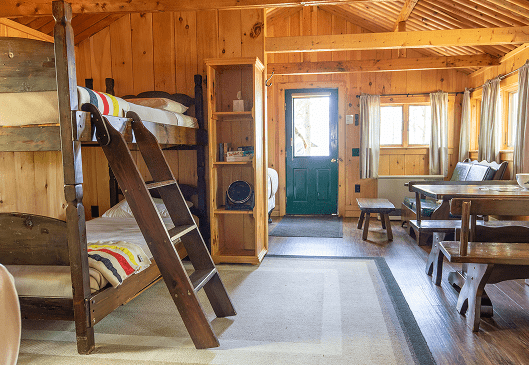
If you are looking for an opportunity to break out of your daily routine behind glass, then check out this seasons fall packages at the New England Outdoor Center. We offer the best of both worlds. Our four season cabins are tucked on the shores of Millinocket Lake. Choose from traditional and cozy or “eco-friendly” and modern. All include glass and the comforts of home. To compliment your stay we have designed a number of packages this season to promote living and adventuring in the outdoors. There are opportunities to learn new skills such as knitting, bread making and shelter building. There are also opportunities for families including crafts, story times and hikes. Looking to relax, well we can accommodate that too on our beautiful point overlooking Katahdin. This fall we invite you to come spend some time on the other side of the glass.
Any Mainer knows that tanning is a lofty endeavor. However, futile as it maybe, I found myself this morning trying to attain that sun kissed glow on a logging road in northern Maine. It seemed the perfect plan. I need to prepare for my upcoming nuptial. The dress is strapless and I am the queen of the farmer’s tan. I also needed to walk my dogs, so two birds with one stone, right? Wrong! In my attempt to be efficient, all I returned with was a number of deer fly welts in places they should not have been and pasty white shoulders. I mean really, who wears a tube top in the north woods? I could go on about the practicality of short sleeves, but what I really want to talk about is my marriage. Wedding dresses, white shoulders, tan lines, these things don’t really matter in the long run as I embark on an entirely new chapter in my life: my new family.
As humans we want to connect to something more than the self: family, kin, kindred, clansmen, tribesmen. We have aligned ourselves to the moon, sky and stars, tides and seasons, animals and trees. It is apparent we want to belong and connect to a past, a traceable lineage with roots in countries, cultures and traditions: a family tree. I think to find that family tree and trace its roots we are going to have to go outdoors. It is where the trees live.
Take for example the Boxborough Minutemen. I had the pleasure of escorting them on a wilderness canoe trip down the West Branch of the Penobscot to 1st Debsconeag Lake. These three Dads have decided that to spend time with their sons they need to go outside. This trip in particular included other young men from their community who may not have otherwise been able to have such an experience. In speaking with one of the fathers, the goal is to set up challenges so they do not go looking for other challenges, challenges like drugs and alcohol. And in these challenges meet them together and share the failure or accomplishment, together, as a family.
This trip involved many challenges. The boys portaged around Debsconeag Falls, carrying their canoes and belongings. They ran a small section of white water and faced a head wind. They needed to stay and work together to navigate the boats on their own. They hiked to ice caves, and finally landed on Omaha Beach in the Debsconeag Deadwater. These are things families do. They carry the load, navigate the rough waters and stay together as they make their way to the beach for a much needed rest. In this expedition the boys hopefully learned they can rely on the wisdom of their fathers and rest easy on the branches of their family tree knowing they do not have far to fall. Their next adventures would take them to the top of Katahdin, and down the white water of the Penobscot. Who knows what they will do in the future? We do know; however, being outside is the perfect opportunity to seal a connection, camaraderie or relationship with each other. It is a place to create stories and tell our own without the daily distractions of work and home. Being outside says this is where you belong like no other place.
As a family you might want to put your feet on the ground, set some roots or remember them. And I mean ground, dirt, soil, earth…not tarmac, cement or linoleum. Sink your roots in deep. Find a family, your own or the one around you. Leaves, branches, fur, feathers, deer flies… it is all there for you. Jump on the family tree. The NEOC believes in families. If you look you will find many of our programs are geared towards family in the outdoors. We offer a place to remember your roots, plant your feet firmly on the ground and grow.
I do not like wearing shorts. I spend most of the summer fluctuating between pants, mid length skirts and long dresses, demurely wiping the sweat away that tends to gather on my brow. My experience with modern day media, models and the like, has created a comical loathing of my legs. I never use words like lithe or willowy to describe the physical features I possess. Typically, words like husky, rugged or robust tend to emerge when I think about my legs. No matter what I do run, ski, lift weights, my calves do not get smaller, and I become frightened of moving from the edge of husky to stout and bandy-legged. And so, even more then shorts I hate bathing suits. Anytime I have to buy an article of clothing with the label “this material will stretch” makes me uncomfortable and want to live on bran for the rest of my life. These issues are of course not about health. I am healthy as a…should we say an ox? Yikes! The point is I am healthy. I do all the things I want to do and more ,have all my teeth and a million other blessings in my life. But regarding my legs, they are not in my mind for public consumption. I have happily developed a summer strategy that works for my timid countenance regarding my legs ,and it involves appearing in places where I do not have to wear shorts or anything shorter! What does this have to do with rafting you might ask?
As an employee for the New England Outdoor Center my worst nightmare came true. They asked me to go white water rafting. It makes sense, they operate a white water rafting company, and they hired me to help with the customer programming. Of course, the key feature of rafting is it takes place on the water and generally in warmer months. When people find themselves on the water, in the sun, in 80 degree weather, well…they probably where a bathing suits or shorts. Are you beginning to see the downward spiral in to a white water nightmare? There is always the option of donning a rented wet suit which is even more scary as the “material will stretch”, and to top off the public humiliation you jump into a boat with a bunch of strangers. Not only do you jump into a boat with total strangers, you also get escorted into rapids. Rapids named Bonecruncher and The Exterminator…rapids that contain recirculating holes of water, i.e. The Keeper. Frankly, it scared me.
There are tons of variables a worrier like me conjures up when it comes to white water. I felt vulnerable, exposed (the shorts), and out of control. What did I know about white water rafting? I mean, I had a vague idea of the route but really did not know what to expect. I pondered intently why people do this. Why do people go white water rafting? So, I went. I bucked up, put on shorts and joined a group rafting the lower Penobscot River.
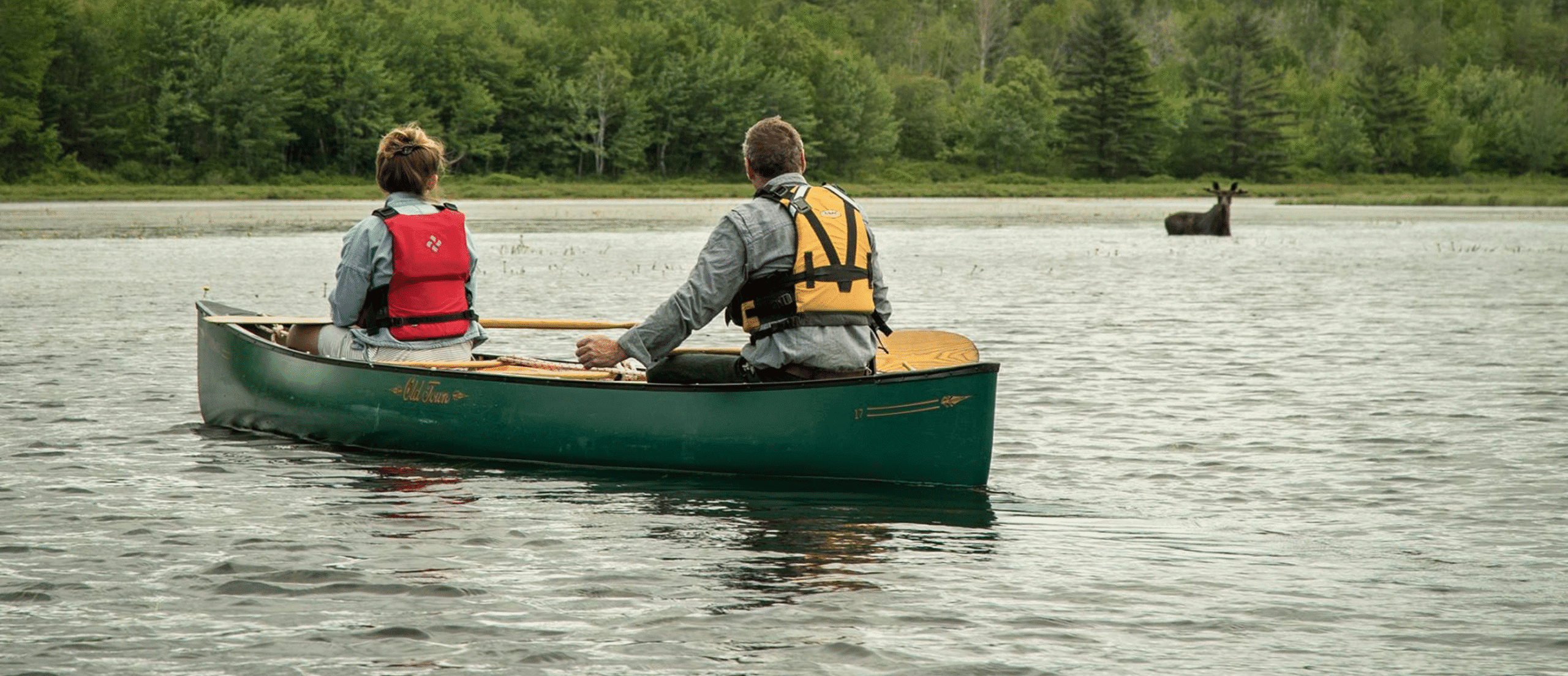
It did not take long to figure out why people go down the river in rafts. The Penobscot is beautiful and the highlight of the day. The rapids are an awesome strike of river reality chased by an exhilarating rush of adrenaline. We saw moose, eagle, and Katahdin. We were in the Maine North Woods. As we floated through the calm currents, it became apparent to me why my experience met none of my preconceived notions. The New England Outdoor Center made it easy to feel safe. I became aware of their careful attention to customer attitudes and abilities. In conversation, I realized the thoughtful navigation of the river to maximize the thrills and the comfort for varying customer expectations. I appreciated the sensitivity to people’s skills or lack thereof and how serious the company was about their deliverance of a quality trip.
I am sure for some, it is a rafting trip, entertaining, enjoyable, and exhilarating. I am sure for others, it is more than that. It is an opportunity to step out of the familiar and in to all that is terrible, like shorts. The New England Outdoor Center treads lightly in this terrible territory, bringing people out the other side safe, sound and smiling. I learned that having been there myself. Thank you to New England Outdoor Center river guides and staff. And thank you to my rugged, robust, husky legs…you did me proud.
Bloodsuckers, fart putty, and Oreos-are not typical items we associate with wilderness adventure. In my mind, wilderness adventure is technical and requires you know how to tie really good knots, knots that hold and are “unknottable”. When I think about wilderness adventure I envision crampons, harnesses and grizzly bears. I see white water, webbing and maps. I know instinctively that it is not for the faint of heart because I recognize that wilderness has no bounds and adventure seeks to find those bounds. The word wilderness alone conjures up majestic visions of mountains, expansive forests, pristine waters; a scared, holy land of quiet, preserved from the all too swift ,hand of man. I think for many of us it is untouchable. We do not have the equipment nor the expertise to go there, so instead we keep wilderness lofty in our psyche to comfort our worn, worked, civilized souls.
But back to bloodsuckers, fart putty and Oreos. Is this wilderness adventure? I certainly have come to believe it. Imagine the backseat of a car: myself 34, with two young children. Annie, 4, is happily entertaining with her bucket of fart putty. Fart putty is basically what it sounds like, putty type substance you smoosh into a small container upon which it makes loud farting noises. She won it fair and square at the local 4th of July festival. Sam, 7, is creating his own fun too, egging Annie on and grabbing for the coveted prize any chance he can. Annie, of course, is screaming and, refuses to share.
In my time with Annie, she has taught me the benefits of the scream…not screaming and crying but just screaming. It is a must for any wilderness expedition. Through her screaming she accomplishes many needed skills for being in the wild. One: a scream can alert to any unforeseen potential danger and; two: it reminds us that it is scary, happy, frustrating, exhilarating to be wild, or in the wild. Any situation in which we scream can be perceived as wild, uncontrollable and without bounds whether on the rollercoaster or on a river. And that was where we were headed, the river.
The Penobscot River is a dynamic, wild space. It offers class V rapids for white water adventures, and subtle, peaceful stretches of current for floating. Is it wilderness? It is wild even though in some parts the Golden Road runs along its eastern side. But again, back to our original thought, does it need to be untouched? Does it need to be inaccessible? Not when you are floating with the Polstein family. 
Regardless of the road or airplanes overheard, we found wilderness. Our rafts on the river took us to natural waterslides, an old hunting camp where we could fish for chubb and wild bloodsuckers (leeches), so adeptly handled by Sam. As we followed the twists and turns and gave in to the wandering current we found eagles, muskrat, moose and a mountain. We rested and swam. We allowed the day to take over, bent happily to her will, and gratefully celebrated with the occasional Oreo. Thank you to Annie, Sam, Max, Jack and Molly, our wilderness experts all under the age of ten.
If you want to add wilderness to your trip, bring a child. It is no coincidence that the words wild and child rhyme. The similarities between the two are uncanny. They are both uncontrollable, unpredictable, impatient, gentle, surprising, amazing, hopeful… Children can take a walk in the park and turn it into an expedition. Children do not need the latest equipment to explore their landscape. Simplicity is the key to enjoying the wild child. As part of our commitment to family adventure, we have developed a series of adventures, packages and activities to get the family into the wilds. The New England Outdoor Center supports the desire people have to connect with nature and wildness. We want to help families find that connection and take it with them. We want to be a part of life-long learning to nurture skills which enable future adventures. We want to inspire a sense of wonder through quality opportunities in the North Maine Woods .
I saw today a very rare and coveted sight. One that some people fear maybe vanishing from our towns, cities and even countryside; a most elusive species which is in danger of losing its spirit to the TV, computer and mass media. You maybe wondering where this sighting occurred and what species I spied…a child in the woods, actually three. Three children in the woods, on a trail, headed to the ice caves with their Dad. We all set out for the ice caves around 7:30am; Annie who is approaching 4, Sam who just turned seven and Max, eight. The ice caves are a natural phenomenon located in the Maine north woods. The hike is a mile and provides an opportunity to capture views of Katahdin as well as ramble through a cool, mossy, forest akin to scenes from the Lord of the Rings. Annie took my hand and she and I proceeded to wind our way through the rocks and roots spying out for toads, birds, mushrooms, whatever caught her eye or mine. Max and Sam ran ahead scouting out the trail and practicing their adventuring skills; I am sure for further, more challenging pursuits. It did not take them long to uncover wild strawberries, spider’s webs and secret hiding places.
Truly, we all found a secret hiding place. Our location just off the West Branch of the Penobscot, amidst the sprawling Debsconeag WildernessArea, embodied the word secret, no other person was to be seen. As the children and I ventured to the caves, they hid amongst the rock, roots and boulders; I hid in the shoulder of Katahdin who sifted in and out of the trees along the trail. It occurred to me as we progressed that we all have to hide, we all have to go somewhere we feel small to remember the significance of our own endeavors. The Hurd Pond road may not sound like it can lead to magic or secret hiding places but at the end of it we found we could easily disappear into the woods, hiding for a time.
There is a lot to learn in the woods, not just names of trees, plants or birds, but how to cope, be uncomfortable, take risks, and… be quiet. In rambling with children not every questions needs to be answered, but sometimes met with the same curiosity. Adults are full of answers, right or wrong, we answer the phone, texts, e-mails. Our whole adult life is about responding and reacting, fixing and solving. Our intentions are typically well-meaning especially when it comes to children. We pick up, prepare, give, enable, whether it is out of habit or convenience, we can miss the opportunity to assist them in discovery. We can miss the opportunity to ask questions ourselves, which in turn, no doubt ,will lead to more questions. Then you are off and running, together on a treasure hunt, and it isn’t really about answers any more but about wondering and creating.
And that is where I found myself on this trek. It wasn’t hike, not in the way adults think of a hike. It was a treasure hunt, and if you talked to Annie
a grueling one. Annie learned a lot about being tired. She held my hand the whole way to the caves. Together we found many ways to assuage the tiredness, whether we sang songs, looked for fairy houses or took breaks to pick a snack. We asked questions. We asked more questions, and marveled even more without answers. Annie and I both discovered what it meant to be sassy and strong. The boys’ lessons ,although similar, took a more independent edge. As treasure hunters no stone was left unturned even potentially dangerous ones. Learning to adventure safely is important to anyone, whether we are heading off to college, the city, a new job. We all have to calculate risks and how to sort the good from the bad. Sam and Max sought plenty of opportunity to practice such skills with Dad for guidance. Do not underestimate what you can learn from a boulder.
The ice caves are mysterious and they remain so. Why is their ice in them? How does this happen? I can answer these questions, and when prompted will but Annie, Max and Sam developed their own conclusions, which were far more interesting than mine. When I think about offering up all the answers, well, frankly, the ice caves aren’t as cool, don’t mind the pun, as they once were.
The New England Outdoor Center recognizes the significance of the local environment. We, as a company, believe in the spirit of adventure, and want to nurture that in our visitors. We want to promote experiences which will, and can have long-lasting positive effects in people’s lives. We hope that positive change will follow them home or on their next adventure. Through the activities we have designed for families, like the hike to the ice caves, we wan
t to assist parents in cultivating outdoor skills and environmental values, especially those parents who may not know where or how to support their children in the outdoors. We are excited to be a part of the national trend to get families up, out, and fostering healthy lifestyles.
Note:
The Eighth Intelligence was coined by Howard Gardner, a well-known, professor who originally published Frames of Mind: A Theory of Multiple Intelligences. In the 90′s he identified an eighth intelligence to compliment the others. The Naturalist intelligence,” enables humans to recognize, categorize and draw upon certain features of the environment”. (Gardner, 1999).
Works Citied
Gardener, Howard. Intelligence Reframed: Multiple Intelligences for the 21st Century. New York: Basic
Books, 1999. Print.
Further Reading
Louv, Richard. Last Child in the Woods: Saving Our Children from Nature Deficit Dis-order.
North Carolina: Algonquin Books, 2008.